
I am Tsung-Yeh Hsieh, a Ph.D. student in Mechanical Engineering at Carnegie Mellon University, working in the Computational Bio-Modeling Lab advised by Prof. Jessica Zhang.
I build AI systems for physical and biological problems, with a focus on graph neural networks, Neural ODEs, transformers, physics-informed learning, AI agents, and GPU-accelerated simulation. Before joining CMU, I received my M.S. and B.S. degrees from National Tsing Hua University.
🔥 News
- 2026.09: Released MGRD, an arXiv preprint on compact, variance-aware neurite forecasting across simulation and microscopy data.
- 2026.07: Co-authored a bioRxiv preprint on predicting macroscopic axon topology from microscopic growth kinematics in cortical neurospheres.
- 2025.09: Passed the Ph.D. qualifying exam at Carnegie Mellon University.
- 2025.07: Presented autoencoder-based surrogate modeling work at the 18th U.S. National Congress on Computational Mechanics in Chicago and received a Travel Award.
Older news
- 2024.08: Started Ph.D. study in Mechanical Engineering at Carnegie Mellon University.
- 2024.05: Presented shock wave modeling work at the Engineering Mechanics Institute Conference and Probabilistic Mechanics & Reliability Conference in Chicago.
- 2023.10: Received Third Place in the Student Paper Competition at the NCFD Conference, Taiwan.
- 2023.08: Presented advection-dominated flow modeling work at the 28th National Computational Fluid Dynamics Conference in Taipei, Taiwan.
- 2023.07: Presented numerically enhanced PINN work at the 17th U.S. National Congress on Computational Mechanics in Albuquerque, New Mexico.
🤖 Current Research
- Machine Learning for Physical Systems — Graph neural networks, Neural ODEs, transformers, PINNs, and surrogate models for learning complex dynamics.
- AI Agents for Scientific Computing — Agents that automate simulation setup, execution, validation, analysis, and iteration.
- Scalable Scientific Computing — GPU and parallel simulation tools that provide training data and physical foundations for AI-for-science systems.
⚡ Featured Engineering Project
GPU-Accelerated IGA for Flow and Transport
Built a validated C++/CUDA simulation pipeline for flow and transport in complex branching geometries. The system provides scalable, physics-grounded data generation for scientific machine learning and digital-twin applications.
Performance highlights: across three branching-neuron cases, the V100 backend completed the reported end-to-end runs in 7.87–78.52 s and was 36.0×–154.5× faster than the legacy NeuronTransportIGA CPU implementation.
| Case | Nodes / elements | Legacy CPU | HexSim CPU | TubularFlowIGA CPU | TubularFlowIGA V100 |
|---|---|---|---|---|---|
| bifurcation | 14,565 / 12,780 | 442.68 s | 71.98 s | 26.75 s | 7.87 s |
| NMO_54499_shrink | 16,344 / 14,040 | 589.32 s | 69.61 s | 33.03 s | 16.39 s |
| NMO_66748_subtree | 57,456 / 50,940 | 12,127.80 s | 137.36 s | 98.77 s | 78.52 s |
Runtimes are case- and hardware-specific; see the benchmark documentation for validation and scope.
Repository · Benchmark details
📝 Publications
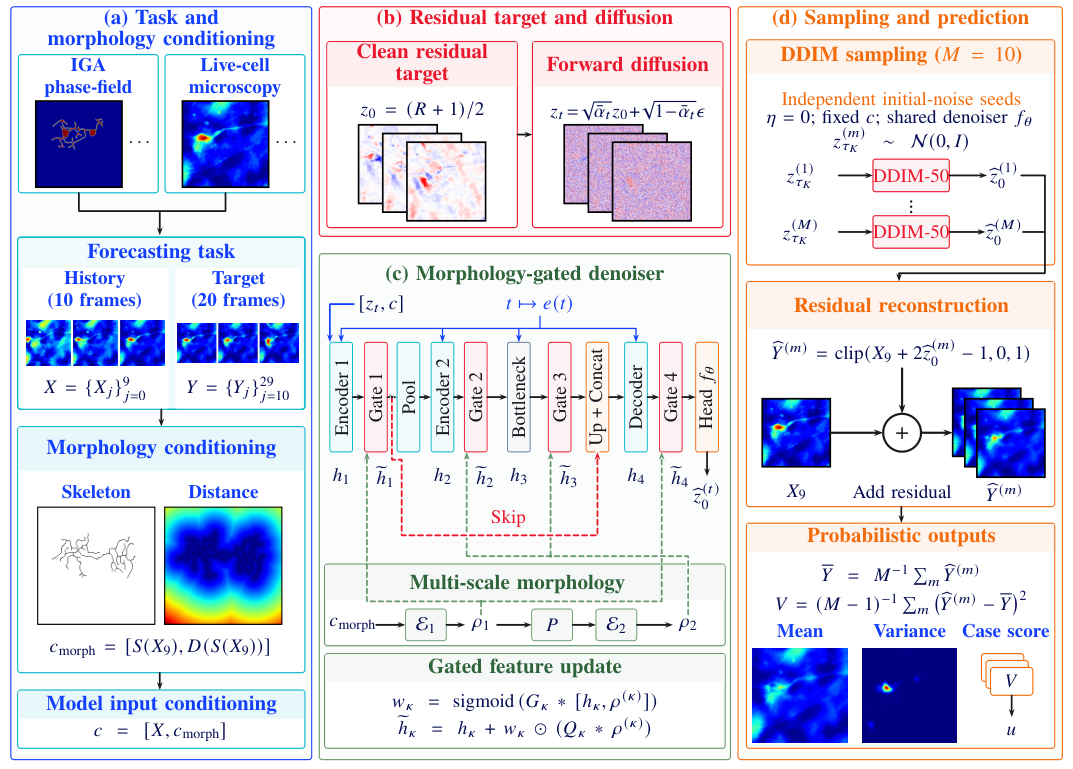
MGRD: Compact morphology-gated residual diffusion for variance-aware cross-domain neurite forecasting [link]
T.Y. Hsieh, C. Anitescu, C. Kim, V.A. Webster-Wood, Y.J. Zhang
arXiv preprint, 2026
- Forecasts 20 future neurite-morphology frames from 10 observations, with repeated sampling to estimate forecast variability. Reduced trajectory-wise mean MAE by 39.6% and improved skeleton F1 by 45.3% over gSTA on human iPSC-derived neuron microscopy, using 1.01% of its parameters.
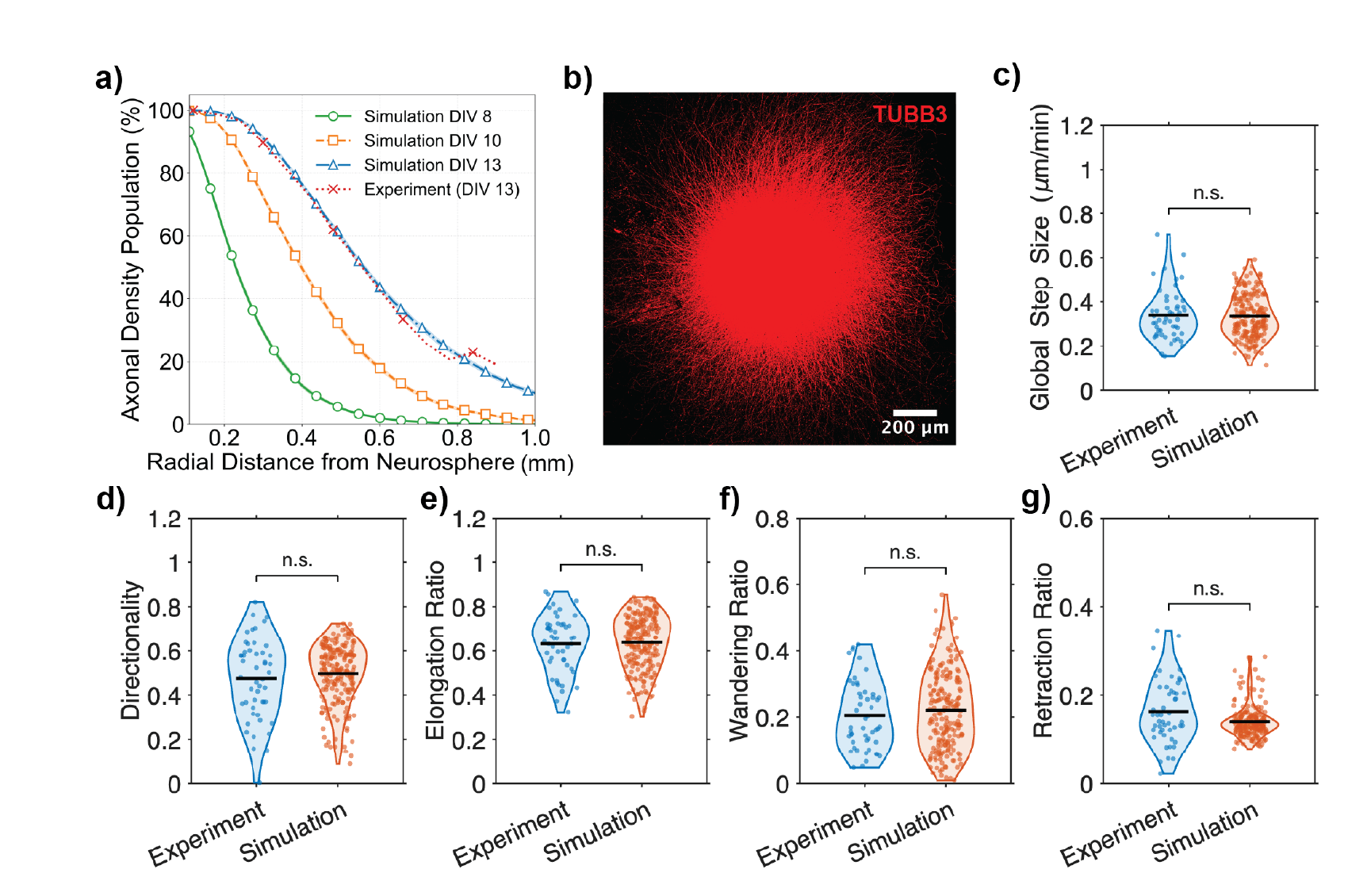
Predicting Macroscopic Axon Topology from Microscopic Kinematics: An Interactive Tracking and Random Walk Pipeline for Substrate-Dependent Cortical Neurospheres [link]
C. Kim, M. Kim, H. Cao, T.Y. Hsieh, Y.J. Zhang, T. Cohen-Karni, V. Webster-Wood
bioRxiv, 2026
- Linked single-axon growth dynamics to network-scale topology; the generative model reproduced both microscopic behavior and macroscopic axonal density.

Decoding the Neural Enigma: Digital Twins of Neurons Revolutionize Brain Research [link]
T.Y. Hsieh, A. Aldirany, J. Zhang
SIAM News, 2026
- Discussed digital twins of neurons and their role in computational brain research.

GALDS: A Graph-Autoencoder-Based Latent Dynamics Surrogate Model to Predict Neurite Material Transport [link]
T.Y. Hsieh, Y.J. Zhang
Computer Methods in Applied Mechanics and Engineering, 2025
- Achieved approximately 3% mean relative error and <8% maximum relative error on unseen geometries and abnormal transport cases. Delivered 10× faster inference with 20× less training data, 10× fewer trainable parameters, and 6× faster training than the prior surrogate approach.

A Multiscale Stabilized Physics-Informed Neural Networks with Weakly Imposed Boundary Conditions Transfer Learning Method for Modeling Advection-Dominated Flow [link]
T.Y. Hsieh, T.H. Huang
Engineering with Computers, 2024
- Developed a stabilized PINN formulation for advection-dominated flow problems with weak boundary-condition enforcement and transfer learning.

An Efficient Parameterized Neural Network Enhanced Multiscale Finite Element Modeling for Triply Periodic Minimal Surface Meta-Structures and its Applications for Femur [link]
Y.Z. Chen, C.H. Wang, T.Y. Hsieh, C.C. Tung, P.Y. Chen, T.H. Huang
Journal of Materials Research and Technology, 2024
- Contributed to neural-network-enhanced multiscale finite element modeling for TPMS meta-structures and biomedical applications.
The full publication list is available on Google Scholar.
🔬 Selected Projects
- Scientific ML for Physical Systems: Built graph neural networks, Neural ODEs, transformers, PINNs, and reduced-order models for PDEs and biological transport.
- AI Agents for Simulation: Developing agentic workflows for simulation setup, execution, validation, analysis, and iteration.
- Biological Imaging and Neural Dynamics: Developed neuron image segmentation and tracking methods and transformer-based models for biological time series.
- AI for Materials and Structures: Developed neural constitutive models, anomaly-detection methods, and multiscale surrogate models for structural and material systems.
- Human Brain MRI Segmentation with MATLAB: A seed-guided BrainWeb demonstration combining Gaussian-mixture EM, morphological processing, and 3D region growing, with physical volume measurement and reference-label evaluation. The fixed example achieves Dice 0.9769 on one simulated human MRI. Source code.
- ScottyBites · CMU Free-Food Companion: A map-first campus food prototype with walking-aware meal plans, evidence-backed event details, RSVP reminders, and a playful Scotty companion. Try the interactive demo · Source code. The demo uses sample events and stores plans locally in your browser.
💼 Experience
- 2017 - 2024: Research Assistant, National Tsing Hua University. Managed and participated in interdisciplinary research projects and helped maintain Linux and Windows research servers.
- 2022: Teaching Assistant, Mechanics of Materials. Served as TA team leader; student rating: 4.9/5.0.
- 2020 Season: Head of Power Mechanical Group, NTHU Racing Team. Led electric race car reducer, timing system, and high-voltage charger projects.
🧰 Technical Skills
- Machine Learning: Python, PyTorch, JAX, graph neural networks, Neural ODEs, transformers, and physics-informed neural networks.
- Scientific Computing: C/C++, CUDA, MPI, PETSc, FEniCS, numerical methods, and high-performance computing.
- Tools and Visualization: Docker, Git, Linux, and ParaView.
🤝 Academic Service
- Journal Reviewer, Computer Aided Geometric Design (CAGD).
- Journal Reviewer, Engineering with Computers (EWCO).
📖 Education
- 2024 - Present: Ph.D. in Mechanical Engineering, Carnegie Mellon University. Computational Bio-Modeling Lab, advisor: Prof. Jessica Zhang.
- 2021 - 2023: M.S. in Power Mechanical Engineering, National Tsing Hua University. GPA: 4.08/4.3. Advisor: Prof. Tsung-Hui (Alex) Huang.
- 2017 - 2021: B.S. in Power Mechanical Engineering, National Tsing Hua University. Electrical and Control Division, advisor: Prof. J. Andrew Yeh.
🎖 Honors and Awards
- 2025.07: Travel Award, 18th U.S. National Congress on Computational Mechanics, Chicago, Illinois.
- 2023.10: Third Place Award, Student Paper Competition, NCFD Conference, Taiwan.
- 2022.12: Top Quarter Award, AI Cup Competition, Ministry of Education, Taiwan.
- 2022.12: Honorable Mention Award, Student Poster Competition, TSFD Conference, Taiwan.
- 2020.12: Honorable Mention Award, Capstone Project Competition, PME Department, NTHU, Taiwan.
- 2019.08: 9th Place Award, Formula SAE Japan, SAE International, as a team award.
🎤 Academic Presentations
View academic presentations
- A Multi-Dimensional Framework for Efficient Material Transport Simulation in Complex Neurite Network Using Autoencoder-Based Surrogate Models, T.Y. Hsieh, Y.J. Zhang. 18th U.S. National Congress on Computational Mechanics, Chicago, Illinois, Jul. 2025.
- A Space-Time Modularized Neural Network Approach for Shock Wave Modeling, T.Y. Hsieh, Y.M. Tsai, T.H. Huang. Oral presentation, Engineering Mechanics Institute Conference and Probabilistic Mechanics & Reliability Conference, Chicago, Illinois, May 2024.
- Shock Wave Modeling with Enhanced Physics-Informed Neural Networks, T.Y. Hsieh, Y.M. Tsai, T.H. Huang. Oral presentation, Conference on Theoretical and Applied Mechanics, Yunlin, Taiwan, Nov. 2023.
- An Enhanced Physics Informed Neural Networks for Shock Wave Modeling, T.Y. Hsieh, Y.M. Tsai, T.H. Huang. Oral presentation, Association of Computational Mechanics Taiwan Annual Meeting, Keelung, Taiwan, Oct. 2023.
- Application of Artificial Neural Network Formulation for Advection Dominated Fluid Flow Problems, T.Y. Hsieh, T.H. Huang, Y.M. Tsai. Presented by Y.M. Tsai on behalf of T.Y. Hsieh, 28th National Computational Fluid Dynamics Conference, Taipei, Taiwan, Aug. 2023.
- Numerically Enhanced Physics Informed Neural Network for Fluid Flow Problems, T.Y. Hsieh, T.H. Huang. Presented by T.H. Huang on behalf of T.Y. Hsieh, 17th U.S. National Congress on Computational Mechanics, Albuquerque, New Mexico, Jul. 2023.
- Artificial Neural Network Methods for Advection Diffusion Problems, T.Y. Hsieh, T.H. Huang. Oral presentation, Conference on Theoretical and Applied Mechanics, Kaohsiung, Taiwan, Nov. 2022.
- A Neural Network Enhanced Finite Element Method for TPMS Based Mechanical Metamaterials Simulation, Y.Z. Chen, T.Y. Hsieh, T.H. Huang, C.C. Tung, P.Y. Chen. Oral presentation, WCCM/APCOM, Yokohama, Japan, Jul.-Aug. 2022.
- Deep Energy Method: A Neural Network Based Meshfree Solver for Hyperelastic Material, T.Y. Hsieh, T.H. Huang. Oral presentation, Conference on Theoretical and Applied Mechanics, virtual format, Nov. 2021.